
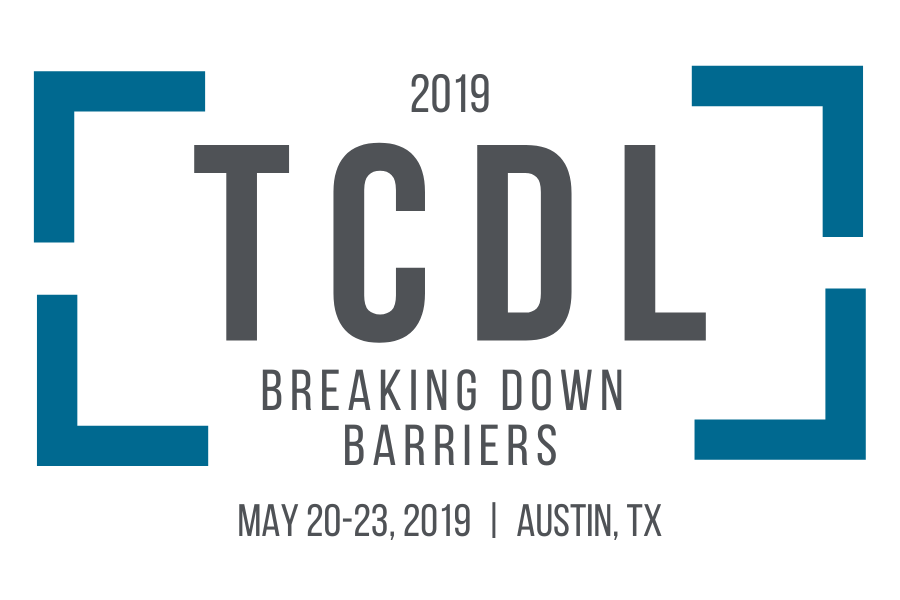
2019 Texas Conference on Digital Libraries
Commons Learning Center, Austin, Texas
10100 Burnet Road
Austin, TX 78758
Dates: May 20 – 23, 2019
Theme: Breaking Down Barriers
Our conference theme seeks to spotlight innovative projects and experiences within digital libraries and other digital work/collaborations. It aims to transform and overcome hurdles between public/technical services and archives; collections and users; the “digital library” and the “library,” and among different disciplines.
Keynote Speaker: Siva Vaidhyanathan

Siva Vaidhyanathan is the Robertson Professor of Media Studies and director of the Center for Media and Citizenship at the University of Virginia.
He is the author of Antisocial Media: How Facebook Disconnects Us and Undermines Democracy (Oxford University Press, 2018). He also wrote Intellectual Property: A Very Short Introduction (Oxford University Press, 2017), and The Googlization of Everything — and Why We Should Worry (University of California Press, 2011). He has written two previous books: Copyrights and Copywrongs: The Rise of Intellectual Property and How it Threatens Creativity (New York University Press, 2001) and The Anarchist in the Library: How the Clash between Freedom and Control is Hacking the Real World and Crashing the System (Basic Books, 2004). He also co-edited (with Carolyn Thomas) the collection, Rewiring the Nation: The Place of Technology in American Studies (Johns Hopkins University Press, 2007).
Vaidhyanathan directs the Center for Media and Citizenship at the University of Virginia, which produces a television show, a radio program, several podcasts, and the Virginia Quarterly Review magazine. He has appeared in an episode of The Daily Show with Jon Stewart to discuss early social network services. Vaidhyanathan has appeared in several documentary films, including Terms and Conditions May Apply (2013), Inside the Mind of Google (2009), and Freedom of Expression (2007). In 2016 Vaidhyanathan played a prominent role in the higher-education documentary, Starving the Beast. Vaidhyanathan was portrayed as a character on stage at the Public Theater in New York City in a play called Privacy (2016). Vaidhyanathan served on the board of the Digital Public Library of America. from 2012 through 2018.
Vaidhyanathan has written for many periodicals, including The New Yorker, The New York Times, Bloomberg View, IEEE Spectrum, American Scholar, Dissent, The Chronicle of Higher Education, The New York Times Magazine, Slate.com, BookForum, Columbia Journalism Review, Washington Post, The Guardian, Esquire.com, The Virginia Quarterly Review, The New York Times Book Review, and The Nation. He is a frequent contributor to public radio programs. And he has appeared on news programs on BBC, CNN, NBC, CNBC, MSNBC, and ABC.
After five years as a professional journalist, he earned a Ph.D. in American Studies from the University of Texas at Austin. Vaidhyanathan has also taught at Wesleyan University, the University of Wisconsin at Madison, Columbia University, New York University, McMaster University, and the University of Amsterdam. He is a fellow at the New York Institute for the Humanities and a Faculty Associate of the Berkman Center for Internet and Society at Harvard University. He was born and raised in Buffalo, New York and resides in Charlottesville, Virginia.
Opening Keynote Session on May 22, 2019
“Antisocial Media: How Facebook Disconnects Us and Undermines Democracy”
If you wanted to build a machine that would distribute propaganda to millions of people, distract them from important issues, energize hatred and bigotry, erode social trust, undermine respectable journalism, foster doubts about science, and engage in massive surveillance all at once, you would make something a lot like Facebook. Facebook grew out of an ideological commitment to data-driven decision making and logical thinking. Its culture is explicitly cosmopolitan and tolerant of difference and dissent. Both its market orientation and its labor force are global. Facebook also indulges a strong missionary bent, one that preaches the power of connectivity and the spread of knowledge to empower people to change their lives for the better. No company better represents the dream of a fully connected planet “sharing” words, ideas, images, and plans. No company has better leveraged those ideas into wealth and influence. No company has contributed more to the global collapse of basic tenets of deliberation and democracy. How did the mission go so wrong? Facebook’s leaders believed that good intentions were enough, and that blind faith in technology could generate a better world.
A big thank you to our keynote sponsor:

Conference Proceedings
The 2019 TCDL Conference Proceedings are available in the Texas Digital Library (TDL) repository.
TCDL 2019 Announcements
Sponsors
Thank you to our 2019 TCDL sponsors!
– Connect Level –

– Capacity Level –


– Network Level –


– Leadership Academy Level –


TCDL 2019 Planning Committee
Chair: Clarke Iakovakis, Oklahoma State University
Vice-Chair: Marcia McIntosh, University of North Texas
Shelley Barba, Texas Tech University
Jon Crossno, UT Southwestern
Taylor Davis-Van Atta, University of Houston
Taylor Fairweather, West Texas A&M University
Kara Long, Baylor University
Jeremy Moore, University of Tennessee Knoxville
Jessica Neal, Trinity University
Mark Phillips, University of North Texas
Sarah Potvin, Texas A&M University
Linda Reynolds, Stephen F. Austin State University
Kristen Weischedel, UT Rio Grande Valley
Amanda Zerangue, Texas Woman’s University
About the Texas Conference on Digital Libraries
Since 2007, the Texas Digital Library has hosted the annual Texas Conference on Digital Libraries (TCDL). TCDL covers topics relevant to the creation, promotion, dissemination, and preservation of research, scholarship, and cultural heritage digital materials. The goal of TCDL is to bring together those working on digital projects — including outreach librarians, repository managers, catalogers, faculty members, technical staff, and others — in order to build a practical, usable, and sustainable model for digital libraries.
TCDL encourages and welcomes participation from students, scholars, librarians, researchers, faculty, and users from all backgrounds, identities, and experiences. All are welcome!
Read TCDL’s Code of Conduct and Land Acknowledgement.